

Running a small business in Nevada is genuinely exciting. The state is business-friendly, the tax climate is enviable, and the weather is good. It’s the desert, so we’ll call it “characterful.” But there’s one area where Nevada means serious business: data privacy. And if you collect customer information, Nevada data breach notification compliance is not optional. It’s the law.
I’ve put this guide together specifically for small business owners who are juggling seventeen things at once and don’t have time to read 40 pages of statutes. Let’s break it down clearly, accurately, and dare I say enjoyably.
- Nevada’s NRS 603A identity theft law applies to any business that collects personal data on Nevada residents even if you’re based out of state.
- If you experience a breach, you must notify affected residents “without unreasonable delay.” There’s no fixed day count.
- Personal information includes names combined with SSNs, driver’s license numbers, financial account numbers, and more.
- The Nevada Attorney General privacy enforcement office has the authority to pursue injunctions and civil penalties up to $5,000 per violation.
- Encrypt your data. Seriously. It’s your most powerful safe harbor.
What Is Nevada’s Data Breach Law, and Does It Apply to You?
Nevada Revised Statutes (NRS) 603A.220 requires operators of internet websites and other data collectors to notify Nevada consumers when they experience a data breach.
That’s the core of it. But before you think “I’m just a small boutique surely this doesn’t apply to me,” let’s pump the brakes.
Nevada’s data breach notification law applies to businesses, government agencies, and third-party service providers that handle personal information of Nevada residents. Under NRS 603A.220, any “data collector” that owns, licenses, or maintains such data must comply including companies outside Nevada if they process state residents’ personal information.
So if you run an e-commerce shop in Ohio with Nevada customers, you’re in scope. Think of it like Nevada’s long arm reaching across state lines to tap you on the shoulder.
When Nevada’s NRS Chapter 603A was first proposed, it only required businesses to notify consumers in the event of a data breach. Since then, the law has been expanded and amended on several occasions. Today, the law grants resident consumers various privacy rights and requires operators and data brokers to adhere to strict data protection regulations.
What Counts as “Personal Information” Under NRS 603A?
This is where small business owners sometimes get surprised. It’s not just credit card numbers floating around on the dark web.
Nevada law defines personal information under NRS 603A.040 as an individual’s first name or first initial and last name combined with a Social Security number, driver’s license number, state identification number, or financial account details, including credit or debit card numbers with security or access codes.
The types of personal information covered by the law also include medical identification numbers, health insurance identification numbers, or information such as a username and password that would permit access to an online account.
Think of it this way: if a hacker could use the data to impersonate your customer or drain their bank account, Nevada considers it covered. Reasonable enough.
Nevada Data Breach Notification Compliance: Your Step-by-Step Obligations
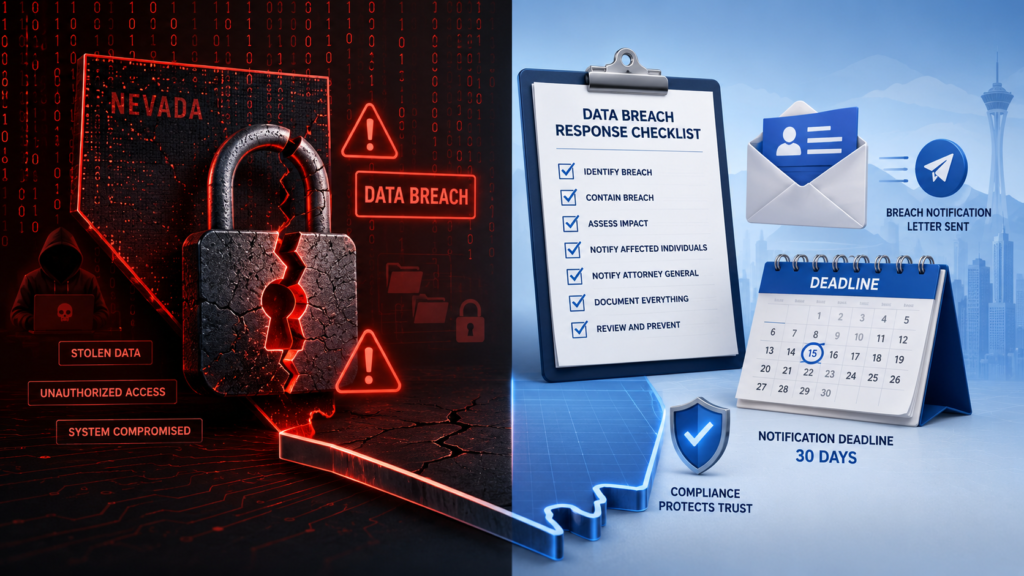
Step 1 Detect and Assess the Breach
No one wants to find out their systems have been compromised. But once you do, the clock is ticking.
When a breach occurs and unencrypted personal information of a Nevada resident is reasonably believed to have been acquired by an unauthorized person, notice is required. Once a breach is discovered, you must notify affected Nevada residents “in the most expedient time possible and without unreasonable delay,” allowing time only to determine scope, restore system integrity, and accommodate a documented law-enforcement hold.
There is no fixed day-count in Nevada law, so set internal timelines that avoid unnecessary delay.
I’d recommend treating this like a smoke alarm. Don’t wait to see if the fire gets bigger before doing something.
Step 2 Notify the Right People
Nevada businesses that experience a data breach must notify all residents whose personal information was compromised. Permitted methods include written notice and electronic notice.
The notice must describe the breach, the types of compromised information, and steps taken to address the incident. It should also provide guidance on protective measures, such as monitoring financial accounts or placing fraud alerts.
And here’s a threshold small businesses often miss: if a breach affects more than 1,000 residents, the business must also notify consumer reporting agencies that maintain nationwide consumer files, in addition to notifying affected consumers directly.
Step 3 Know When Substitute Notice Is Allowed
Not every business has the resources to mail thousands of letters.
If direct notice would cost over $250,000, the affected class exceeds 500,000 persons, or you lack sufficient contact information, you may use substitute notice consisting of email notice (if you have addresses), conspicuous posting on your website, and notice to major statewide media.
For most small businesses, you’ll never hit those thresholds. But it’s good to know the escape hatch exists.
The Encryption Safe Harbor Your Best Friend in Nevada
Here’s a genuinely good piece of news, and I don’t say that lightly.
Notification is required only when personal information involved in the breach was unencrypted (or otherwise not rendered unreadable). Nevada’s definition of personal information expressly hinges on the data not being encrypted, and certain truncated identifiers are excluded. This encryption “safe harbor” means incidents involving properly encrypted data without compromise of the key generally do not trigger the notice requirement.
That’s huge. Encrypting your stored and transmitted data isn’t just good small business data security in Nevada, it’s your legal shield.
Nevada has specific requirements for encryption of sensitive data in its data breach laws. According to the state’s Data Privacy Law, any person or entity that conducts business in Nevada and collects certain personal information is required to encrypt that information if it is transmitted electronically outside of a secure system.
Nevada Attorney General Privacy Enforcement: What’s at Stake
Let’s talk about consequences because this is where “I’ll deal with it later” gets expensive.
NRS 603A.290 provides the Office of the Nevada Attorney General with enforcement authority.
A violation of Nevada’s breach-notification provisions constitutes a deceptive trade practice, enabling enforcement under Nevada’s Deceptive Trade Practices Act. The Attorney General or a district attorney may seek injunctive relief, and courts may impose civil penalties for willful deceptive trade practices currently up to $15,000 per violation.
If the Attorney General has reason to believe that a business has violated the state data breach notification laws, they may institute appropriate legal action against that party. Businesses that knowingly fail to provide notice of a security breach may receive a temporary or permanent injunction, and could be required to pay a civil penalty of not more than $5,000 for each failure to provide notice.
Here’s the part that makes business owners do a double-take: the court can impose civil penalties of up to $5,000 per violation. The monetary fine is per any website visitor from the State of Nevada, meaning fines can drastically escalate if you have several individuals visiting from Nevada per month.
That math adds up fast. A busy online store could be looking at penalties that dwarf the cost of simply building a solid compliance plan upfront.
Practical Steps to Stay Compliant Right Now
You don’t need a Fortune 500 legal team to get this right. Here’s what I’d prioritize:
Audit what data you collect. Map every place customer personal information lives: your CRM, your payment processor, your email platform. You can’t protect what you can’t find.
Encrypt everything in transit and at rest. This is your single most impactful action. It triggers the safe harbor and dramatically reduces your exposure.
Write a breach response plan before you need one. Decide in advance who contacts customers, who calls legal counsel, and who notifies credit bureaus if you cross the 1,000-resident threshold. Doing this at 2 a.m. during an active breach is not ideal.
Review your vendor contracts.
If a data collector discloses personal information to a third party pursuant to a contract, the contract must require the third party to implement and maintain reasonable security measures to protect those records from unauthorized access, acquisition, destruction, use, modification, or disclosure.
Your vendors’ problems can become your legal problem.
Maintain a clear privacy policy.
Operators in Nevada must include certain disclosures in their privacy policies regarding the information they collect.
Keep it plain-language and accurate. Regulators are not fans of vague promises.
FAQ: Nevada Data Breach Compliance for Small Businesses
Q: Do I have to notify the Nevada Attorney General’s office when a breach occurs?
Interestingly, no not directly for the breach notification itself.
Unlike the majority of U.S. states, Nevada does not require businesses to notify the Attorney General or any other state agency when a data breach occurs.
Your primary obligation is to notify the affected individuals. That said, the AG still has full enforcement authority if you fail to do so.
Q: What if a breach happens through no real fault of my own like a vendor hack?
A good-faith acquisition by an employee or agent for legitimate purposes that is not misused or further disclosed is not a trigger for notice.
But if a third-party vendor you hired is breached and your customers’ data is exposed, you’re still on the hook for notification. This is why vendor due diligence matters so much.
Q: Can I get a grace period to fix a compliance issue before the AG takes action?
For online privacy opt-out violations specifically, yes.
Nevada’s privacy law allows operators and data brokers to rectify their first failure to comply with consumers’ opt-out requests and notice requirements. If the business rectifies such violation within 30 days after being informed, no legal actions may arise.
For breach notification failures, however, time is of the essence from the start.
The Bottom Line on Nevada Data Breach Notification Compliance
Nevada’s data privacy framework isn’t designed to trap small businesses, it’s designed to protect real people from very real harm. And honestly, the core requirements are reasonable once you understand them: encrypt your data, notify people promptly when something goes wrong, and write down your plan before you need it.
The businesses that struggle are the ones who assume “that won’t happen to me.”
Every small business that handles credit cards or stores customer information is vulnerable to data breaches.
The question isn’t whether you’re a target, it’s whether you’re prepared.
Start with a simple data audit this week. Map your customer data, check your encryption settings, and dust off (or draft) that incident response plan. It’s less glamorous than a new marketing campaign, but it might just save your business.
Ready to take the next step? Share this article with your operations manager or IT provider and if you’d like help building a data security checklist tailored to Nevada requirements, reach out. Compliance is a team sport, and you don’t have to play it alone. Check out our legal and identity theft protection services.
*This article is for informational purposes only and does not constitute legal advice. For guidance specific to your business, consult a qualified attorney familiar with Nevada privacy law.*