

Let me be direct: if you’re running a small business in Las Vegas and think you can’t compete for talent without a Fortune 500 benefits budget, I’d like to politely disagree. The good news is that non-insurance employee benefits for small businesses are more accessible, more affordable, and frankly more interesting to employees than ever before. And in a city where the competition for reliable, skilled workers is real hospitality, retail, construction, professional services all fishing in the same talent pool, the right non-insurance perks can be the difference between a great hire and a vacancy that costs you more than you’d think.
So let’s talk about what actually works.
Las Vegas small businesses don’t need massive insurance budgets to attract and keep great employees. Non-insurance employee benefits like legal benefit plans, EAPs, financial wellness programs, flexible scheduling, and professional development are low-cost, high-impact tools that build loyalty and reduce turnover. Voluntary benefits let employees customize their perks without breaking your payroll. Start with one or two, communicate them clearly, and build from there.
Why Non-Insurance Benefits Matter More Than You Think
Since 69% of employees find that a competitive benefits plan is “very important” for employee retention, providing one can help you attract and retain top talent from all generations.
That statistic alone should make you sit up a little straighter.
But here’s where it gets interesting for small business owners.
Small businesses can stay competitive by focusing on personalized benefits and flexibility rather than expensive traditional group health insurance plans.
Translation: you don’t need to out-spend the Marriott to out-benefit them.
Over 40% of employees are reconsidering their jobs, exceeding the turnover rates of the Great Reshuffle era.
For a Las Vegas small business, losing even one key employee triggers a cascade of lost productivity, recruiting costs, training time, and the slow erosion of team morale. Retention isn’t a soft goal. It’s a hard financial one.
The conversation has moved beyond traditional benefits like health insurance or retirement plans. Today, organizations are focusing on how employee perks can genuinely enhance employee satisfaction, improve work-life balance, and bring about a more equitable work environment.
The Most Effective Non-Insurance Employee Benefits for Small Business
1. Employee Assistance Programs (EAPs)
This one is wildly underrated.
An Employee Assistance Program (EAP) is a voluntary, work-based program that offers free and confidential assessments, short-term counseling, referrals, and follow-up services to employees who have personal and/or work-related problems.
Think of an EAP as a mental-health-meets-life-coach program that employees actually use when things get hard and things always get hard eventually.
These programs are private and can offer employees things like counseling, financial advice, and legal help.
The employer upside?
Employees who are engaged and satisfied with their work tend to stick around longer. Not only can access to an EAP empower employees to lead healthier, more fulfilling lives, but offering an EAP as a benefit demonstrates that you care about their overall well-being, which can increase feelings of loyalty to your organization.
And for the cost-conscious (which is all of us),
EAPs can offer a range of benefits, often flexible and at little to no cost, that help employees with challenges that may affect them at work, from mental health issues to financial needs.
That’s a lot of value for a small line item.
2. Legal Benefit Plans for Employees
This one flies completely under the radar, and I think that’s a mistake.
As benefits become more modular, personalized packages often include voluntary options at group rates, such as ID theft protection, accident coverage, critical illness, legal plans, and transportation benefits.
Legal benefit plans for employees give workers access to attorneys for everyday needs, wills, landlord disputes, traffic tickets, family law questions at a fraction of what they’d pay on their own.
Whether buying a new home, drawing up a will, or just needing some legal advice, a legal plan can give employees easy access to experienced, participating attorneys, plus a wide range of covered legal services for a low monthly fee.
Imagine you have an employee going through a difficult landlord dispute which, in Las Vegas’s rental market, is not a hypothetical. Without a legal plan, they’re stressed, distracted, and Googling attorneys on their lunch break. With one, they make a phone call and get back to work. Everyone wins.
3. Financial Wellness Programs
Amid ongoing financial insecurity and rising living costs, financial wellness is central to the employee benefits package.
This is especially true in Nevada, where many workers in service industries live paycheck to paycheck.
Financial services through EAP or standalone programs can connect employees with help to improve financial wellness budgeting advice, achieving healthy spending habits, loan consolidation, debt repayment, setting up an emergency fund, and more.
Competitive offerings include 401(k) plans with employer match, student loan repayment assistance, debt counseling, budgeting tools, and early wage access. In a high-cost environment, these benefits can materially improve retention because they reduce day-to-day financial strain while strengthening long-term security.
You don’t have to offer all of these at once. Start with one even a free financial coaching resource via an EAP and build from there. Small steps, real impact.
4. Voluntary Benefits: Let Employees Build Their Own Package
Here’s a concept that works beautifully for small employers with tight budgets.
Voluntary benefits are insurance products and perks offered by an employer but paid for partially or fully by employees, usually through convenient payroll deductions. Unlike core benefits such as medical insurance or retirement plans, these are optional.
The key advantage?
Employers gain a more competitive benefits package, while employees get access to coverage at group pricing they may not secure on their own.
It’s a win that costs you almost nothing in direct outlay.
More employers are extending voluntary benefits such as wellness programs, financial wellness coaching, and tuition reimbursement.
These programs let employees pick what actually matters to them which, if you have a multigenerational workforce (and most Las Vegas businesses do), is genuinely important.
5. Professional Development and Career Growth
According to a study by LinkedIn, 94% of employees would stay longer at a company that invests in their career development and professional growth.
That number is almost suspiciously high, but let’s take it at face value because career growth matters enormously to workers.
Employees are more likely to stay when they see a clear path for growth. This could include offering training programs, workshops, or certifications that align with the employee’s interests and the company’s demands.
In practical terms, this can be as affordable as a LinkedIn Learning subscription, a tuition reimbursement policy (even a modest one), or simply a structured mentorship conversation once a month. It’s less about the dollar amount and more about the signal: *we’re investing in you.*
6. Flexible Scheduling and Lifestyle Perks
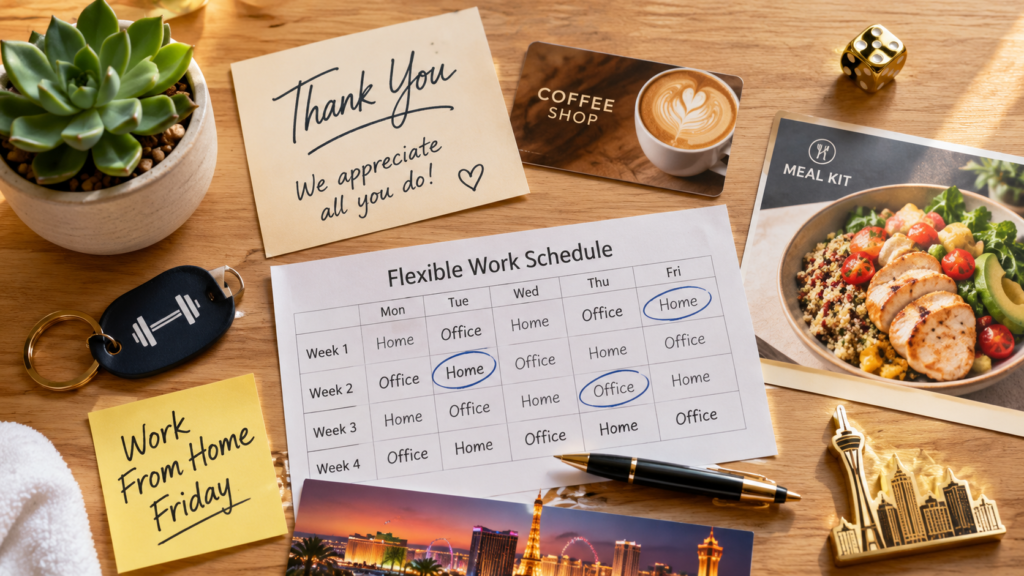
Las Vegas is a 24/7 city, which creates both the challenge and the opportunity.
80% of employees identify flexible work arrangements as a crucial factor in job evaluation and satisfaction, and 61% have left, or considered leaving, a position due to the lack of flexibility.
Flexible scheduling isn’t just remote work.
Flexibility in work arrangements can take various forms, including remote work options, flexible hours, compressed workweeks, or even job sharing.
For a Las Vegas small business, even something as simple as offering employees first choice on preferred shifts can register as a meaningful perk.
To minimize costs associated with a small business employee benefits program, consider non-traditional benefits such as flex scheduling, employee assistance programs, or telecommuting. Low-cost benefits such as paid time off enhancements, free meals, or rewards for a job well done can also incentivize employees.
A gift card for a local restaurant, an extra PTO day on a birthday, or team lunches none of this breaks the bank, and all of it builds goodwill that retention surveys consistently reward.
How to Build Your Affordable Workforce Perks Strategy in Nevada
The temptation is to try and offer everything at once. Resist it.
For smaller employers, this doesn’t have to mean “all at once.” Many organizations start with education, EAP counseling, and virtual care, then layer coverage over time based on utilization and workforce needs.
Here’s a simple framework I’d suggest: Start with an EAP; it’s typically the lowest-cost, highest-perceived-value benefit you can offer. Add a legal benefit plan or financial wellness resource next, since these address real, everyday employee stressors. Then layer in voluntary benefits so employees can customize without straining your budget. And build professional development into your culture as an ongoing conversation, not a one-time training event.
Your business benefits package signifies your investment in your employees’ future. That’s why 41% of business leaders will focus on improving their employee benefits packages this year.
You’re in good company and you don’t need to outspend competitors to outthink them.
FAQ: Non-Insurance Employee Benefits for Las Vegas Small Businesses
Q: Do I need a big HR department to manage voluntary or non-insurance benefits?
Not at all.
Offering voluntary benefits, financial wellness coaching, and clear communication through modern benefits administration platforms can help attract and retain top talent. Tools now make it easier for smaller teams to collect employee feedback, manage employee perks, and deliver a consistent employee experience without the overhead of large HR departments.
Q: What’s the most cost-effective non-insurance benefit I can start with today?
An EAP is the classic answer, and for good reason.
Once employees use the resources in an EAP, the effects are tangible, including an increase in workplace satisfaction and a decrease in turnover.
Many EAP providers offer very affordable per-employee-per-month pricing, making it realistic even for the smallest Nevada employer.
Q: Are legal benefit plans only useful for employees with complex legal needs?
Far from it. Legal benefit plans for employees cover everyday situations reviewing a lease, updating a will, addressing a consumer dispute that most people face at some point.
Many EAPs and legal benefit plans offer flexible services across two broad categories: help for life changes and challenges, and help with legal and financial questions.
The value is in the accessibility, not the complexity.
The Las Vegas talent market isn’t slowing down, and your competitors are already rethinking their benefits packages. But here’s the thing: you don’t need a sprawling HR budget to build something employees genuinely appreciate. Non-insurance employee benefits for small businesses, legal plans, EAPs, financial wellness, voluntary perks, flexible scheduling, career development are your tools for competing on a level that goes beyond the paycheck.
Pick one benefit from this list. Implement it. Tell your team about it clearly and often (benefits that go uncommunicated are benefits that don’t exist). Then build from there.
If you’d like help designing a non-insurance benefits strategy tailored to your Las Vegas small business, reach out to us as your benefit advisor who understands the Nevada market and your industry. The conversation is worth having and it costs less than you think to get started.