

If you’ve ever thought, “We’re too small to be a target,” I’ve got some news and a box of tissues, just in case. Employee identity theft risks in 2026 have grown into one of the most financially devastating threats facing small businesses today. And they’re coming from directions most owners never saw coming.
We’re not just talking about a stolen wallet or a suspicious credit card charge. We’re talking about AI-generated fake employees, deepfake video calls, and email scams so convincing that even savvy finance teams get fooled. The landscape has changed fast. So let’s break down exactly what’s happening, what it’s costing, and the good news about what you can actually do about it.
Employee identity theft is no longer a “big company problem.” In 2026, small businesses are primary targets. AI-powered fraud, business email compromise, and data breaches are draining businesses of tens of thousands to millions of dollars. The fix? Layered protection, smart training, and identity security treated as a core business strategy not an afterthought.
The State of Employee Identity Theft Risks in 2026
The numbers are, frankly, jaw-dropping.
81% of small businesses reported suffering a security breach, a data breach, or both in the past year.
That’s not a niche problem. That’s practically every small business owner reading this article.
And the confidence to handle these threats? It’s collapsing.
The percentage of small business leaders who felt “very prepared” for a cyberattack plummeted in 2026 to 38.4%, compared to 56.5% in 2024.
In one year, confidence dropped off a cliff. That’s the kind of stat that should make you put down your coffee and pay attention.
If you think your small business is safe from identity thieves and that they only target individual consumers or very large companies, you are mistaken. Small and mid-size businesses have become attractive targets due to the potential rewards and the numerous opportunities that thieves have found to exploit them.
Think of it like this: a small business is a corner store with a glass door, while a large corporation is a bank vault. Which one do opportunistic criminals try first?
How Much Is a Small Business Data Breach Actually Costing?
Let’s talk money because the small business data breach costs in 2026 are genuinely staggering.
On average, small businesses can expect to pay $120,000 to $1.24 million to respond and resolve a security incident.
And that range assumes you catch it fast.
Downtime from a cyberattack costs $53,000 per hour, and 40% of small businesses say a cyberattack costing $100,000 or less would put them out of business.
Let that sink in: a single afternoon of disruption could be your last.
It gets worse.
47% of businesses with fewer than 50 employees allocate zero cybersecurity budget, and only 17% of US small businesses have cyber insurance despite being prime targets.
That’s a recipe for disaster wearing a “we’ll be fine” smile.
29% of small businesses that suffer a data breach lose customers permanently due to trust issues.
So you don’t just lose money in the attack itself you lose the relationships that took years to build. The math here is brutal and unambiguous.
Business Email Compromise: The $3 Billion Sucker Punch
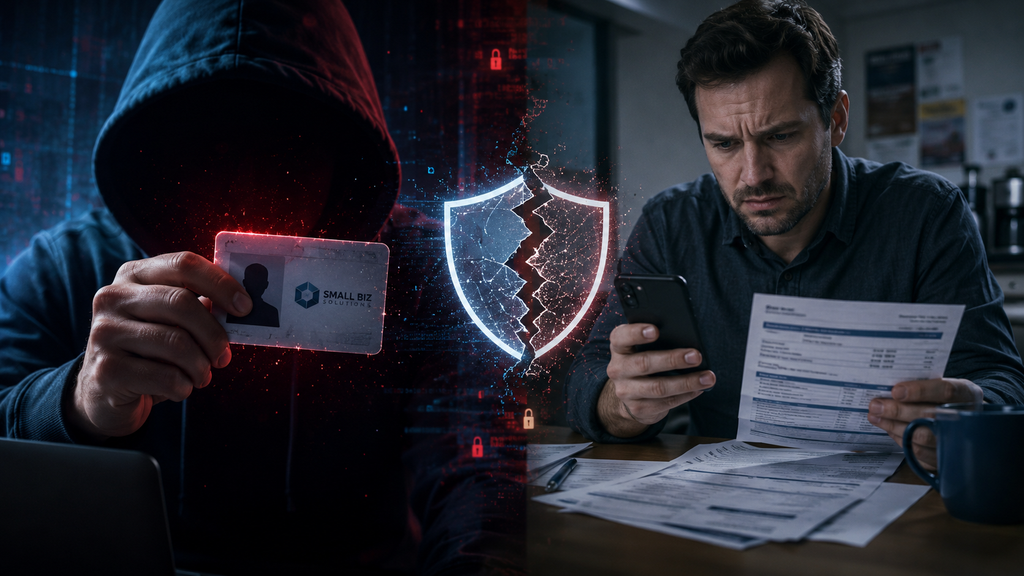
Of all the threats feeding into employee identity theft risks in 2026, business email compromise losses deserve their own spotlight. Why? Because this one hits employees directly and it works embarrassingly well.
Business email compromise is a scam where fraudsters use social engineering tactics to pose as company executives or trusted vendors to lure employees into transferring funds.
It sounds simple. But it’s devastatingly effective.
The FBI has tracked BEC since 2013, reporting annual increases in losses, with companies losing over $3 billion in 2026 alone, a $250 million jump from the prior year.
And business email compromise rose 60% between just January and February of 2026.
That’s two months. Sixty percent.
These attacks involve fraudsters impersonating trusted contacts such as executives, suppliers, or internal staff to trick employees into sending payments or confidential information, and BEC scams have become increasingly sophisticated, often slipping past traditional email security filters.
The average BEC wire transfer request was $24,586 in early 2026.
And here’s the painful kicker: nearly 30% of insurance claims involve BEC funds transfer fraud and only about 25% of claims see any meaningful recovery. Meanwhile, 14% of BEC scam victims recovered none of their financial losses.
AI Identity Fraud: The New Threat Your Employees Aren’t Ready For
This is where things get genuinely sci-fi. AI identity fraud against employees isn’t a future concern, it arrived, and it arrived loudly.
AI-powered attacks were identified as a root cause in more than 40% of cyber events, marking a significant shift in how breaches actually happen. And,deepfake fraud attempts are up 2,137% over the last three years. Deepfakes made up just 0.1% of all fraud attempts three years ago today they account for roughly 6.5%.
The FBI’s Internet Crime Complaint Center logged approximately $893 million in AI-enabled fraud losses in 2026 the first year the agency tracked AI as its own category.
That’s not a warning sign. That’s the fire alarm already blaring.
The workplace infiltration angle is particularly alarming.
AI and deepfakes are infiltrating the workplace, and at Money20/20 USA in October 2026, a leading technology firm revealed that up to 50% of job applications it receives are fake.
Fake employees. Sitting in virtual meetings. Accessing your systems. It sounds like a thriller novel but it’s Tuesday.
Nearly 62% of hiring professionals believe job seekers are now better at faking their identities with the help of AI than HR teams are at detecting those deceptions. Only 13% disagreed.
And once a fraudulent hire gets in?
There’s a real risk to your business’s security if an employee’s personal credentials are compromised, it can open a backdoor for cybercriminals to access your company’s sensitive data.
The Employee Impact Nobody Talks About Enough
Here’s something often buried under the financial statistics: identity theft doesn’t just hurt the business. It genuinely derails the lives of the people who work for you.
Resolving identity theft often requires employees to take unexpected time off for phone calls, appointments, or legal consultations disrupting workflow and adding pressure to the rest of the team. Even when physically present, a burdened employee may be mentally absent leading to errors, missed deadlines, and a general decline in work quality.
30.89% of incidents occur due to employee account takeover.
That means nearly one in three identity fraud events at the workplace level starts with a compromised employee account, not a sophisticated nation-state hack, just a stolen login. Sometimes the front door really is unlocked.
Workplace Identity Protection: What Actually Works
Here’s the upbeat part. Because yes, this is fixable. And we don’t have to become cybersecurity engineers to do it.
Build a Culture of Verification
Organizations can make deepfake fraud far harder to pull off by requiring a callback or shared passphrase for any request involving a wire transfer, password reset, or sensitive data confirmed through a channel the attacker does not control. Multi-factor authentication should be turned on everywhere sensitive systems live.
Think of MFA like a deadbolt on your digital front door. Passwords alone are a screen door in a hurricane.
Train Employees on What Real Threats Look Like
BEC email scams can look quite innocent. Hackers use AI to mimic the writing styles of known colleagues and employ psychological triggers like urgency or authority to disrupt your critical thinking process.
Training your team to pause before acting on “urgent” financial requests is one of the cheapest and most effective defenses available.
Run regular security awareness training that specifically covers deepfake and voice-cloning scenarios, not just email phishing.
Apply Role-Based Access Controls
Not all employees require access to every category of data. By applying role-based access controls, you ensure that sensitive information is only visible to authorized personnel minimizing the risk of accidental exposure or internal misuse.
Offer Identity Protection as an Employee Benefit
This one’s a win-win.
Over 80% of employees consider identity theft protection among their most valued workplace benefits.
And by offering employee identity protection benefits as part of your core package, you’re not just providing a service, you’re investing in their peace of mind, their productivity, and the long-term resilience of your business. It’s a relatively small investment that yields substantial returns.
FAQ: Employee Identity Theft Risks 2026
Q: How do employees become targets for identity theft at work?
The most common entry points are phishing emails, account takeovers, and compromised credentials.
The Verizon 2026 Data Breach Investigations Report found credential abuse (22%) and exploitation of vulnerabilities (20%) continue to be the leading initial attack vectors.
Employees are often targeted simply because they have access to systems, payments, or sensitive data.
Q: How does employee identity theft affect a small business financially?
The impact goes well beyond the initial incident.
A data breach costs more than the ransom, the invoice, or the repair bill. It can shut down work, drain cash, shake client trust, and pull leadership away from growth.
Factor in lost customers, legal fees, and compliance penalties, and even a “small” breach can threaten survival.
Q: What’s the fastest thing a small business can do to reduce identity theft risk for employees?
Start with multi-factor authentication and phishing-awareness training both are low-cost and high-impact.
Prevention costs 50–60 times less than recovery.
That stat alone should inspire a Monday morning security meeting.
Don’t Wait for the Breach to Care
Employee identity theft risks in 2026 are real, rising, and expensive. From AI-powered deepfakes slipping into your hiring pipeline to BEC scams bleeding wire transfers out the door, the threats have gotten smarter. But so have the solutions.
The good news is that you don’t need an enterprise IT budget to build meaningful protection. You need awareness, a plan, and a team that knows what to look for. Start with MFA. Train your people. Apply access controls. And seriously consider identity protection as part of your benefits package your employees will thank you, and so will your balance sheet.
The businesses that come out ahead in 2026 and beyond won’t be the ones who got lucky. They’ll be the ones who got prepared.
Ready to shore up your workplace identity protection strategy? Start here.