

So you’ve decided to plant your entrepreneurial flag in the Entertainment Capital of the World. Honestly? Smart move. When you register a small business in Las Vegas, you’re stepping into one of the most business-friendly states in the country and I’m going to walk you through every step so you don’t accidentally fold a winning hand.
To register a small business in Las Vegas, you’ll complete four main steps:
(1) form your business entity with the Nevada Secretary of State via the Silverflume Nevada business portal, (2) get a state business license, (3) obtain a Clark County and/or City of Las Vegas business license, and (4) register any DBA name with the Clark County Clerk. Budget roughly $425+ for LLC formation, plus local licensing fees.
Why Las Vegas Is a Great Place to Start a Business
Before we get into the paperwork, let me give you a quick pep talk.
Nevada offers zero state income tax, streamlined online registration, and business-friendly regulations.
That’s not a typo, no state income tax. Vegas isn’t just great for a bachelor party; it’s genuinely one of the most welcoming environments for new business owners.
Now, let’s get into it.
Step 1: Choose Your Business Structure
Think of this step like picking your seat at the table; it shapes everything that follows. Your main options are sole proprietorship, partnership, LLC, or corporation. Most small business owners in Las Vegas go with an LLC because it combines flexibility with liability protection.
After choosing your structure, you register your business entity with the Nevada Secretary of State. LLCs file Articles of Organization, while corporations file Articles of Incorporation.
Easy enough, right? Now let’s talk about *where* you actually do that.
Step 2: Register Your Entity on the Silverflume Nevada Business Portal
This is where the magic happens online, in your pajamas, which is honestly how all government paperwork should be done.
You can complete this registration online through SilverFlume, which is the state’s official business registration website.
Head to nvsilverflume.gov, create an account, and you’ll receive an activation link by email.
Once you’re in, you’ll use the portal to complete a business registration checklist, file your LLC’s formation documents, and provide its business registration data.
For an LLC specifically, you must submit your Articles of Organization, Initial List of Managers or Members, and state business license application form and to file these formation documents on SilverFlume, you must pay at least $425.
One heads-up worth noting: the Nevada Secretary of State has created a new online business portal called “Project ORION” that will replace SilverFlume in the summer of 2026, so some information provided may not apply to the new system.
Keep an eye on the Secretary of State’s website for updates.
The good news on speed?
Most transactions are available via the online portal, SilverFlume, and will be processed the same day for no additional charge.
Same-day processing. I wish the DMV took notes.
Step 3: Obtain Your Nevada State Business License
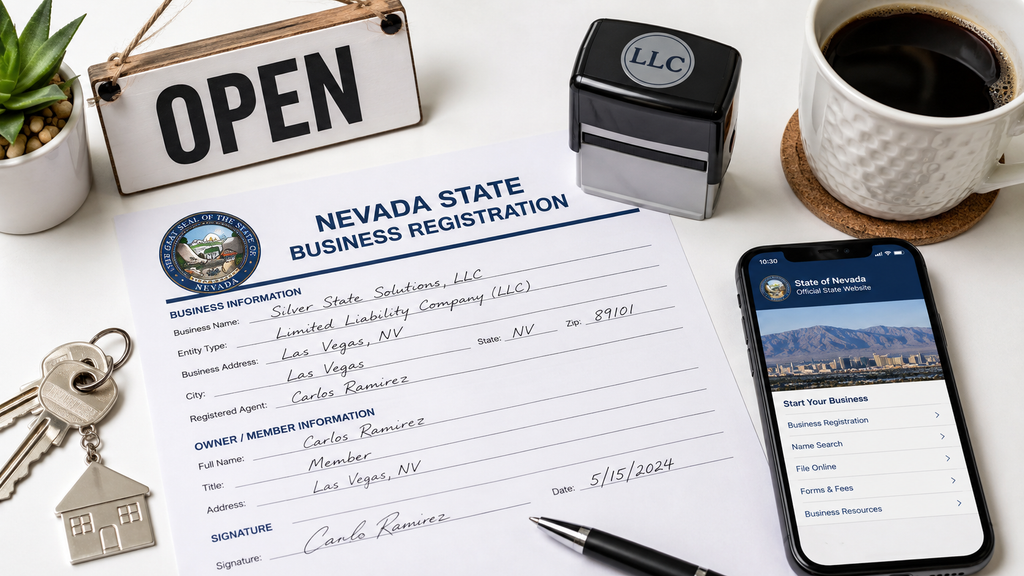
Here’s something Las Vegas newcomers sometimes miss: your entity registration and your state business license are two separate things, even though you can handle both on SilverFlume in one session.
You must have an EIN first before applying for a business license,
so grab that from the IRS website before you sit down to file.
The license must be renewed annually to keep your business in good standing with the Nevada Secretary of State.
Miss the renewal and things get painful fast; the state imposes a $100 late fee and marks your business as “default,” and the longer your company remains in default, the more likely the state will revoke your business charter.
So set a calendar reminder. Seriously.
Step 4: Get Your Clark County Business License (and City License)
Here’s where Las Vegas registration gets a little layered like a great club sandwich.
In many cases, you’ll need to obtain business licenses at the state, county, and city levels. If you’re starting a business in Las Vegas, you’ll first need a state-level license, then a Clark County license, and finally a license for the City of Las Vegas.
Clark County Business License
License fees are based upon services and activities provided, and are accompanied by a one-time $45.00 application fee in addition to each license fee. Multiple licenses may be required if providing more than one service.
Most general licenses are issued within 45 days after the Department receives a complete application, and public safety inspections are generally conducted and approved for the business location during this time.
Plan accordingly. 45 days isn’t forever, but it’s not instant either.
City of Las Vegas Business License
In Las Vegas, all businesses (except for professional services like an accountant) must pay a $300 license fee, which breaks down to $250 for the license and $50 for processing.
Also, don’t assume one license covers the whole valley.
The City of Las Vegas, City of Henderson, and Clark County each have separate business license applications, and if you operate in multiple locations across different jurisdictions, you may need a license from each one.
Think of it less like a headache and more like collecting achievements.
Step 5: File a Las Vegas DBA Registration (If Needed)
Planning to operate under a name that’s different from your legal business name? Then you need a DBA or as Nevada officially calls it, a Fictitious Firm Name (FFN). Think of it as your business’s stage name.
A DBA in Nevada is officially known as a “Fictitious Firm Name” (FFN), and under NRS Ch. 602, Nevada handles fictitious firm name registration at the county level through the County Clerk.
In Las Vegas, businesses must file their DBA with the Clark County Clerk’s Office.
If you are planning to establish your business in Clark County, you’ll file at the Clark County Clerk’s Office, Box 551604, Las Vegas, NV 89155-1604, along with a “Certificate of Business: Fictitious Firm Name” and a filing fee of $25.
One important quirk: fictitious firm names must be registered by mail or in person, and the form must either be notarized or signed in person at the clerk’s office.
So this one’s not quite as click-and-go as the state filing. Good thing notaries aren’t hard to find in Vegas.
According to Nevada law, counties may pass an ordinance requiring fictitious firm names to be renewed every five years. Clark County is among those that require DBA renewal, and the renewal fee is typically the same as the original registration fee about $25.
Step 6: Handle Sales Tax and Additional Permits
Almost there! If your business sells physical goods or certain services,
you need a sales tax permit from the Nevada Department of Taxation. Nevada’s statewide sales tax rate is 6.85%, though local taxes can push the combined rate higher depending on the county.
You can register for a sales tax permit online through the Department of Taxation’s website, and there is no fee to obtain the permit, just the obligation to collect and remit. And if your business involves alcohol, food service, or construction, you must ascertain whether your form of business calls for extra permits or licenses, such as food service licenses, liquor licenses, or building licenses.
FAQ: Registering a Small Business in Las Vegas
Q: Do I need both a Clark County business license and a City of Las Vegas business license?
Yes, in most cases.
Businesses in Las Vegas need both a city business license and a Clark County business license if operating in unincorporated areas.
Your exact requirements depend on your physical address, so always verify your jurisdiction first.
Q: What’s the difference between a DBA and an LLC in Nevada?
A DBA only changes the name of your business; it changes nothing else.
An LLC, by contrast, creates a separate legal entity that protects your personal assets. You can actually have both: form an LLC, then file a DBA if you want to operate under a different brand name.
Q: How long does it take to register a small business in Las Vegas?
The state-level entity filing and business license through SilverFlume can be processed the same day online. Local licensing takes longer; most general Clark County licenses are issued within 45 days after the Department receives a complete application.
Specialized or regulated licenses (think liquor or gaming) take considerably more time.
You’re Ready to Deal In
Registering a small business in Las Vegas isn’t as complicated as it might look at first glance. File your entity on the Silverflume Nevada business portal, secure your state license, layer on your Clark County business license and city license, and handle your Las Vegas DBA registration if you’re going by a trade name. That’s really the whole game plan.
The Silver State is genuinely rooting for you with no state income tax, same-day online filings, and a booming local economy make this one of the best places in the country to build something great.
Ready to make it official? Contact us today to take your first step today. Your Las Vegas business story starts right now and I’d bet on you.